
Behind the scenes at 2 Stream: live TV and AI in action

On Sunday, October 4, 2026, 2 Stream opens its studio doors during Voka Open Bedrijvendag, and this time the cameras stay rolling all day.
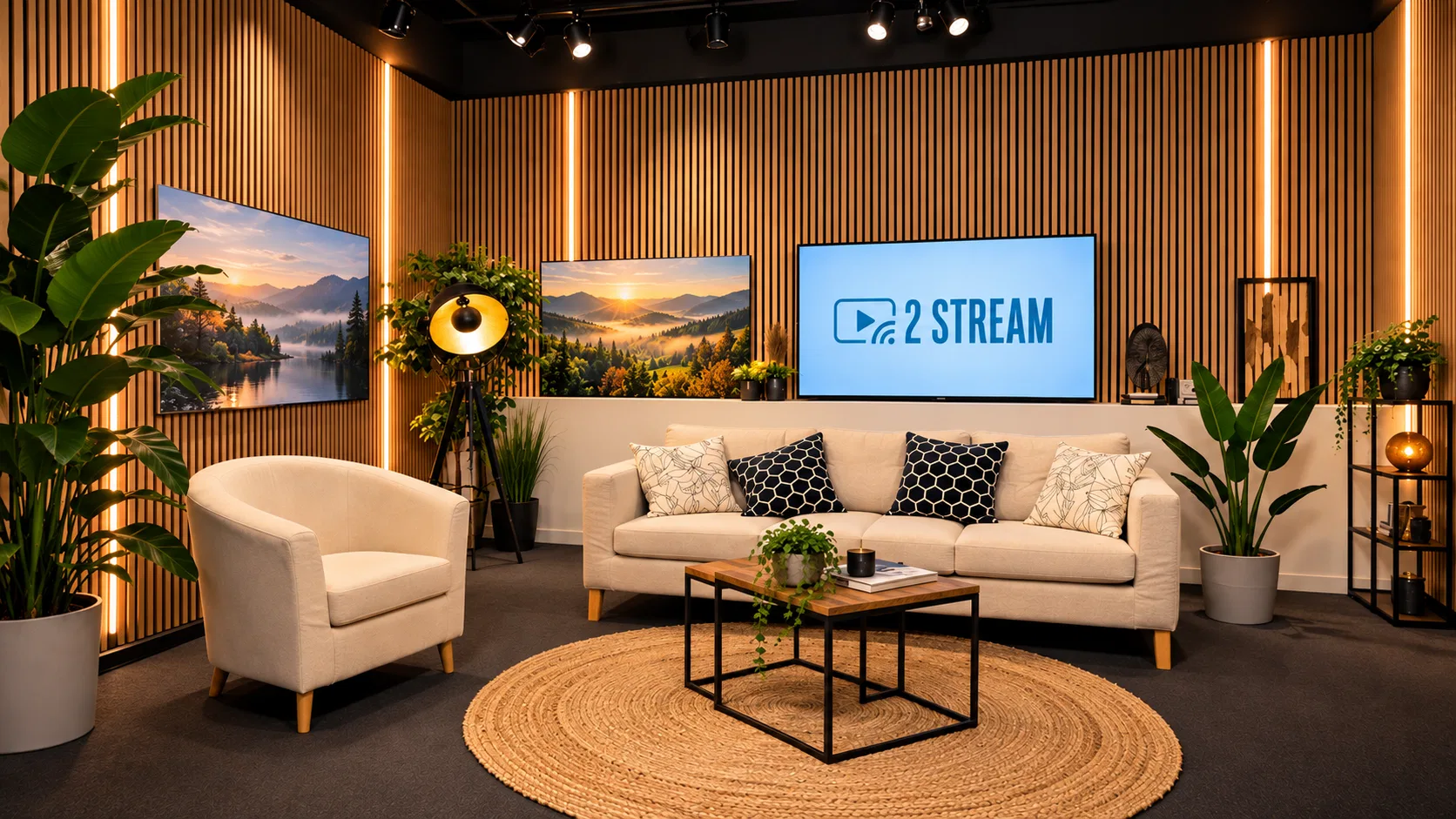
Most people who visit a video production studio expect a tour: some cameras on tripods, a control room with a wall of monitors, maybe a rehearsed walkthrough. That's not what happens at 2 Stream's location at Excelsiorlaan 9 in Zaventem on Sunday, October 4, 2026. The studio runs a real live program throughout the day, with actual panel discussions, actual guests, and actual production pressure. Visitors don't watch a demo. They watch a broadcast happen.
We see this constantly in our work with communications teams preparing high-stakes conferences, government briefings, and international summits: the gap between "we understand livestreaming conceptually" and "we've stood in a control room while it happens" is enormous. Open Bedrijvendag closes that gap for a general audience the same way we close it every week for professional clients. You come to see cameras. You leave understanding how live broadcast actually gets built, second by second.
What actually happens during a live broadcast
A live broadcast is the real-time synchronization of image, sound, direction, speakers, graphics, connectivity, and audience interaction, all happening simultaneously with no room for a second take. That's the core idea 2 Stream wants visitors to walk away with on October 4. Professional livestreaming is, in practice, live television production. Every element has to land at the same instant, and the control room is where that coordination becomes visible.
Throughout the day, Marlène de Wouters presents and moderates the live program. Several sessions and panel discussions run back-to-back, featuring guests from the business world, the events sector, and partner organisations. Visitors watch the full technical chain in motion: cameras and camera operators, a live direction desk switching between shots, sound engineers managing microphones and levels, lighting operators, screen and graphics operators layering information over video, greenkey compositing, remote speakers joining from elsewhere, and the livestream feed going out in real time.
This is the same chain we run for clients across defence, government, and international organisation events, where a dropped signal or a missed cue isn't a minor glitch, it's a reputational problem. Open Bedrijvendag visitors get to see that chain exposed, not simulated. If you've ever wondered what actually needs to work simultaneously in a professional livestream, the studio floor is where you'll see it answered.
Who's on camera and why it matters
Two of 2 Stream's co-founders take active roles in the day's panel discussions, not as company representatives giving a pitch, but as practitioners answering real questions about where the industry is heading.
Christophe Lenaerts, Co-Founder & CCO of 2 Stream, joins one or two panel conversations focused on the evolution of professional video, livestreaming, and hybrid communication. His angle centers on a shift we've watched accelerate across our own client base: organisations no longer treat an event's reach as limited to the people physically in the room. A well-produced hybrid event now extends further, faster, and to more stakeholders than the physical guest list ever could.
Jean-Bernard van Zuylen, Co-Founder & CTO of 2 Stream, sits on the panel dedicated to artificial intelligence and technology in event production. This is where the day gets concrete rather than conceptual. Carlo Schots also joins the AI session. The panel covers three things directly: CenterStage, 2 Stream's Belgian-built platform for live and on-demand events; live AI translation; and how new digital tools get developed and integrated into existing production workflows.
We won't oversell what AI translation does. It makes spoken content during a broadcast available in other languages, and its usefulness depends entirely on the event and its requirements. Some international conferences need it. Some domestic sessions don't. The panel presents it as one tool among several, not a universal fix, which is the same way we scope it when a client asks whether their event needs it.
Why CenterStage matters here
CenterStage is 2 Stream's own platform for live and on-demand event streaming, and its presence at Open Bedrijvendag demonstrates something specific: 2 Stream doesn't just operate cameras and stream signals, it builds the technology layer underneath them.
Visitors get to see how an organisation's own digital event platform can combine with professional video production, live interaction tools, and multilingual delivery in one system. That distinction, between a company that rents out AV equipment and a company that engineers the infrastructure connecting production to distribution, is exactly what we try to make visible whenever we scope a project for hybrid events that need to serve both an in-room audience and a distributed online one.
The AI and technology segment of the day isn't a sales pitch dressed up as a demo. It's a working session showing how existing technology gets integrated into new solutions for events and corporate communication, the same integration work that underpins every multi-camera, multi-location production 2 Stream runs for clients across Belgium and internationally.
Why this matters beyond one Sunday
A single day of open access tells you something that a sales conversation never fully can: what a professional production actually looks like under real conditions, with real timing pressure and real technical coordination.
For organisations weighing whether to bring a conference, summit, or stakeholder event in-house or hand it to a production partner, that visibility matters. In our work producing coverage for large-scale international events, including the USA250 celebration broadcast from Brussels to a global audience, the same fundamentals apply at a much higher stakes level: synchronized direction, reliable connectivity, and a technical team that has done this enough times to handle the unexpected without it showing on screen.
Voka Open Bedrijvendag has run annually on the first Sunday of October since 1991, according to Voka, and 2026 marks its 36th edition (Voka, 2026). The event typically runs from 10:00 to 17:00 across participating companies, though visitors should confirm 2 Stream's specific hours closer to the date (Open Bedrijvendag, 2026). It's a public, family-friendly event, and that's deliberate: the audience for this day includes curious teenagers, families, and anyone interested in TV, streaming, and technology, alongside communications directors and event managers scouting a future production partner.
If you're the latter, this is also a chance to see, in real time, how the technical disciplines behind professional on-location livestreaming come together on a single production day, from camera blocking to graphics overlay to the moment a remote speaker joins a live feed without a visible hitch.
What to look for if you're evaluating a production partner
If you're assessing whether a studio can handle your organisation's live event needs, watch how they manage the handoffs, not just the individual pieces.
Anyone can show you a camera or a streaming encoder. What separates a production team that can run a mission-critical broadcast from one that can't is how cleanly camera switches, audio levels, remote guest connections, and on-screen graphics stay synchronized when something shifts unexpectedly, a guest running late, a network hiccup, a schedule compression. That's the exact judgment call 2 Stream's control room makes dozens of times during the Open Bedrijvendag broadcast, and it's the same judgment call that matters when we run webinar productions from our Zaventem studio for corporate clients five minutes from Brussels Airport.
Open Bedrijvendag gives you a rare, unfiltered look at that decision-making in action, without a client relationship at stake and without anything hidden behind a closed door.
The clearest way to understand professional live production is to watch it happen, not to hear it described, and that's precisely what changes when you spend a few hours in 2 Stream's studio on October 4. You'll leave with a working sense of what "reliable livestream" actually requires technically, which makes it far easier to brief, budget, and evaluate your next hybrid event or conference. If you want to go further than a single visit, get in touch with 2 Stream to arrange a studio tour and conversation about your own event or streaming needs.
Frequently asked questions
What is the best device to use for live streaming?
The best device depends on production scale and stakes. For casual streams, a modern smartphone or webcam suffices. For professional broadcasts, multi-camera setups with a dedicated video switcher, external audio mixing, and a production control room, like the setup 2 Stream runs, are necessary to maintain broadcast-quality image, sound, and reliability under live conditions.
How much does a livestream cost?
Cost depends on production complexity: number of cameras, crew size, venue logistics, graphics and translation needs, and whether the stream is single-location or hybrid with remote speakers. A simple single-camera stream costs far less than a multi-day, multi-language conference broadcast. Request a scoped quote based on your specific event to get an accurate figure.
What equipment do I need for live streaming?
Professional livestreaming requires cameras, a video switcher or direction desk, microphones and an audio mixer, lighting, a reliable internet connection or dedicated streaming encoder, and a platform to distribute the feed. Larger productions add graphics overlays, remote-guest connectivity, and greenkey compositing, all coordinated from a central control point during the broadcast.
Are there AI live streams?
Yes. AI is increasingly used within live streaming for real-time translation of spoken content into other languages, workflow automation, and production support tools. Its usefulness depends on the event's audience and requirements. International conferences with multilingual audiences benefit most, while domestic single-language events may not need it at all.
How to do a behind-the-scenes video?
A behind-the-scenes video works best when it shows real production activity rather than a staged walkthrough, capturing camera operators, the direction desk, and the moments where things get coordinated live. Filming during an actual broadcast, rather than a rehearsed demo, gives viewers a genuine sense of how the production process works.
What happens at Voka Open Bedrijvendag 2026?
Voka Open Bedrijvendag 2026 takes place on Sunday, October 4, 2026, its 36th edition, with hundreds of companies across Flanders and Brussels opening their doors to the public. At 2 Stream in Zaventem, visitors watch a live broadcast in production, including panel discussions on AI, technology, and hybrid events.
Sources
Voka, 2026 — Confirms Voka Open Bedrijvendag's annual date pattern since 1991 and the 2026 edition details.
Open Bedrijvendag, 2026 — Practical information on participating company hours and event logistics for the 2026 edition.

Comments