
What event production companies actually do

An event production company builds and runs the technical infrastructure that makes an event actually work: sound, video, lighting, staging, streaming, and the live operation of all of it. An event planner organizes the event. A production company makes sure it doesn't fail.
That distinction sounds small until you're standing in a control room forty minutes before a NATO-adjacent conference goes live to three continents, and the question isn't "does the room look good" but "will the feed hold." We see this constantly in our work with communications directors and event managers across defence, government, and international organizations: the people booking us have already handled the guest list, the catering, the branding. What they need is someone who guarantees the signal doesn't drop when it matters most.
This article is about that gap, and about why organizations operating between Brussels and Washington increasingly hire a specialist AV and livestream partner alongside, or instead of, a general event agency.
What does an event production company do?
An event production company handles the technical and operational execution of an event: installing and managing sound, lighting, video, staging, and live direction so the event actually delivers what was promised on paper. This covers everything from pre-event technical planning to on-site crew, live operation, and post-event breakdown.
Concretely, that means:
Technical infrastructure: sound systems, lighting rigs, video capture, projection, and streaming equipment configured for the specific venue and audience
Logistics and coordination: managing rental equipment, vendor timing, load-in and load-out schedules, and site-specific constraints
On-site crew: sound engineers, camera operators, streaming technicians, and a director calling the show in real time
Creative execution: translating the client's communication goals into camera angles, graphics, lower-thirds, and pacing that match the message
Full production flow: briefing, technical planning, rehearsal, live execution, and evaluation afterward
This is fundamentally different from event planning. A planner manages the guest experience, the budget, and the vendor relationships. A production company owns the technical layer, the part that determines whether the keynote is audible, the panel discussion streams cleanly to remote stakeholders, and the recording is usable for internal comms six months later.
How is an event production company different from an event planning agency?
An event planning agency manages logistics, guest experience, and vendor coordination. An event production company owns the technical execution, the audio, video, lighting, and live direction that determines whether the event functions as a piece of communication, not just a gathering.
Many organizations already have an event agency. That agency is good at venue selection, catering, registration, and the overall guest journey. What it typically isn't built to do is guarantee broadcast-quality output under pressure. If your event agency's answer to livestreaming is "our AV vendor can handle that," ask what happens when the encoder drops mid-keynote, or when a bilingual panel needs synchronized interpretation channels feeding both the room and a remote audience simultaneously.
In our engagements with public affairs teams and event agencies across Belgium and the EU institutions, the pattern is consistent: the agency handles the experience, we handle the signal. That's a division of expertise that mirrors how the two skill sets actually developed. Event planning is a hospitality and logistics discipline. AV production is a broadcast and engineering discipline. Trying to get one team to be excellent at both is where reliability problems start.
This is also why the "we already have an event agency, why add a production partner" objection misses the point. You're not duplicating the agency's work, you're covering the part of the event that the agency was never staffed or equipped to own.
Why does AV reliability matter more than the wow factor?
AV reliability matters more than visual spectacle because a failed stream or dead microphone doesn't just look bad, it undermines the institutional credibility of everyone on stage. For government, defence, and international organization clients, a broken live feed during a summit or press briefing is a reputational event in itself.
This is the core of what separates a specialist AV production partner from a generalist. Anyone can rent LED screens and make a stage look impressive. Far fewer teams can guarantee that a multi-language panel discussion streams without a hiccup to an audience spread across Brussels, Washington, and a dozen national delegations, on the first take, with no do-overs.
We've shipped this for defence-adjacent conferences and EU-institutional events where the brief wasn't "make it look good," it was "this cannot fail, there is no second take, and half the audience is watching remotely in real time." What works in that environment is redundancy built into the signal chain, technical rehearsal before doors open, and a crew that has run this exact configuration before, not one learning on the job.
This is precisely the scenario where "our IT department says we can stream this ourselves via Teams or Zoom" breaks down. Consumer conferencing tools are built for internal meetings, not for institutional-grade broadcast to external stakeholders, press, or a distributed international audience where quality reflects directly on the organization's credibility. A dropped Zoom call in a team meeting is an inconvenience. A dropped feed during a public affairs briefing is a story.
What does hybrid and international event production actually involve?
Hybrid event production means designing the event twice, once for the room and once for the remote audience, and making sure both experiences land with equal quality. This is harder than it sounds, because most hybrid failures come from treating the online audience as an afterthought bolted onto the in-person event.
Organizations asking "how do we organize our hybrid event for remote employees" or "how do we reach our audience both physically and digitally at the same time" are usually underestimating the production complexity. It's not one camera pointed at a stage. It's camera coverage designed for a screen, audio mixed for headphones rather than a room, graphics and captions built for remote comprehension, and a streaming pipeline that holds up regardless of venue Wi-Fi.
Our approach to hybrid production treats the remote audience as a first-class participant, not a webcam bolted onto a physical event. This matters enormously for organizations running transatlantic programming, where a Brussels-based summit needs to land credibly with a Washington-based stakeholder audience watching live at an inconvenient hour, in a second or third language.
The same logic applies to product launches, annual congresses, and internal town halls. If you want your product launch followed online as seriously as it's experienced in the room, or your internal comms videos to finally look like they belong to a professional organization rather than a hastily-recorded webcam clip, the production standard has to match across both channels.
What determines the cost of a professional event production partner?
Cost is driven by the number of camera angles, the complexity of the streaming destination, crew size, rehearsal time, and whether the event is single-language or multi-language. A single-camera webinar with one presenter costs a fraction of a multi-camera, multi-language, hybrid summit with simultaneous interpretation and a redundant streaming setup.
The factors that actually move the number:
Number of locations and cameras: a single studio recording is far simpler than a multi-site hybrid event spanning Brussels and a remote venue
Streaming complexity: a private link to a handful of stakeholders costs less than a public multi-platform stream with captioning and interpretation
Crew size: director, technicians, and producer scale with the stakes of the event, not just its size
Rehearsal and redundancy: mission-critical events require technical rehearsal and backup systems, which adds time but removes risk
Language requirements: multi-language productions need additional audio channels and often additional crew
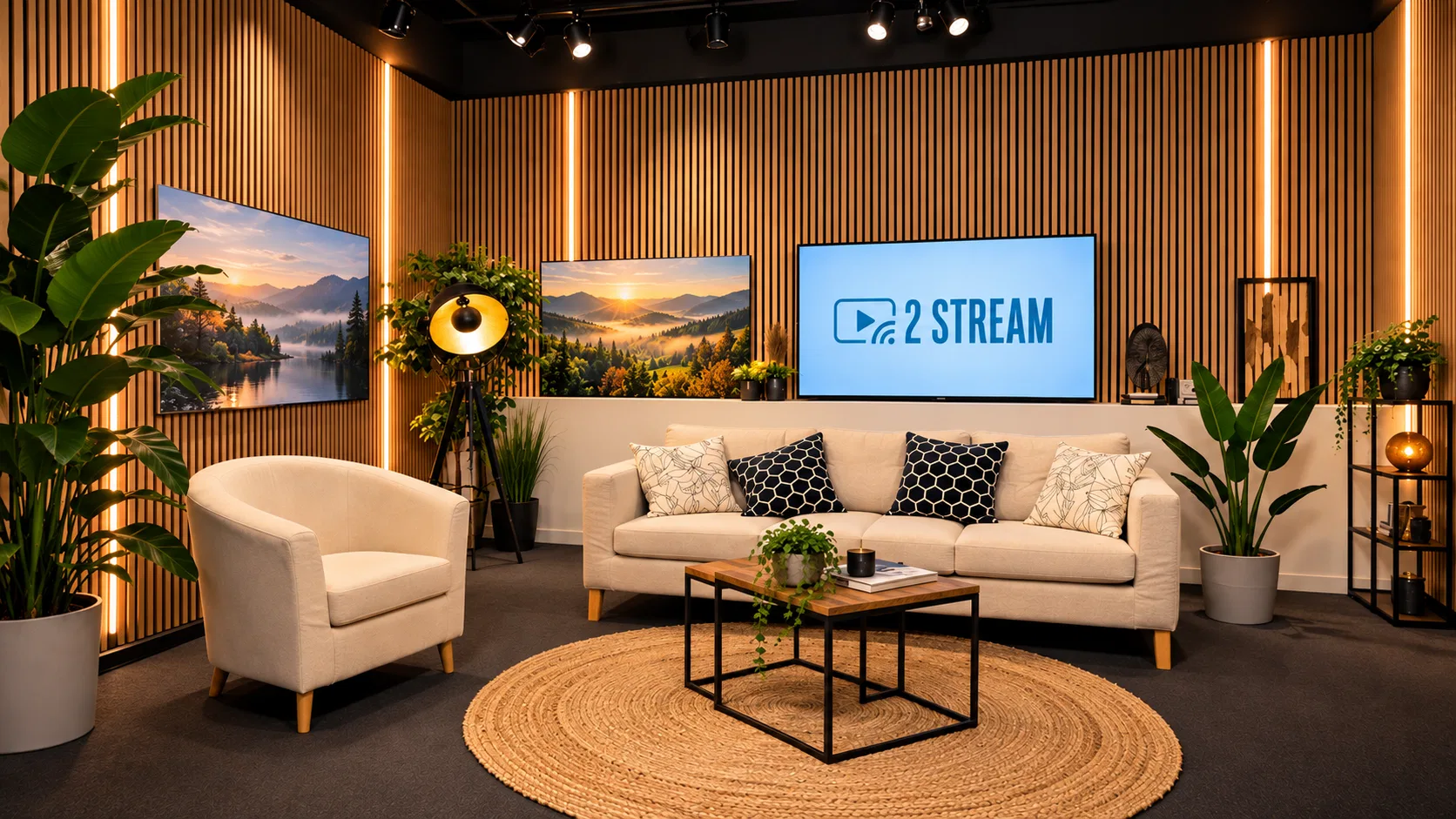
For organizations with a genuinely limited budget for a given event, the honest answer isn't "cut the production partner," it's "scope the production to match the stakes." A smaller internal webinar doesn't need the same redundancy as an EU institutional summit. What doesn't scale down safely is reliability itself, once you've decided the stream matters, it either works or it doesn't. Our webinar studio in Zaventem exists specifically for that middle tier: professional multicam production without the full complexity of a large hybrid summit.
How does 2 Stream fit into this picture?
2 Stream operates as the specialist AV and livestreaming layer that event agencies, communications teams, and public affairs departments bring in when the stakes require broadcast-grade reliability rather than a general logistics package. We work across event production, livestreaming, hybrid events, studio recording, podcasts, webinars, and postproduction, always from the same premise: technical execution and storytelling have to work together, and both have to be measured against outcomes, not just how the room looked on the day.
For creative and communications agencies evaluating event technology partners, the real filter isn't the wow factor of a demo reel, it's whether the process holds up under a live, unforgiving deadline.
The bottom line
An event production company is judged on one thing: whether the technical layer of your event worked, invisibly, while everyone's attention was on the content. That's the entire job.
Once you see the split between "who organizes the event" and "who makes the technology work," you'll evaluate every future proposal by asking which one you're actually being sold, and you'll stop assuming your event agency's AV subcontractor is the same thing as a dedicated production partner.
If your next conference, product launch, or hybrid town hall can't afford a dropped feed, get in touch to schedule a studio tour and conversation and we'll walk through what your specific event actually requires.
Frequently asked questions
What is an event production company?
An event production company handles the technical execution of an event, including sound, lighting, video, staging, and live streaming, rather than the logistics and guest experience planning that an event agency typically manages. It's the team responsible for making sure the show technically works, live, without failure.
What does an event production company actually do day-to-day?
Day-to-day, an event production company plans technical requirements, sources and configures equipment, coordinates crew (technicians, camera operators, directors), runs rehearsals, executes the live event, and manages breakdown afterward. For hybrid or livestreamed events, this also includes managing the entire streaming pipeline to remote audiences.
Do I need a production company if I already have an event agency?
Yes, if your event includes livestreaming, hybrid audiences, or high-stakes AV requirements your agency isn't specifically staffed for. Event agencies excel at guest experience and logistics; they typically aren't built to guarantee broadcast-quality technical execution, which is a distinct discipline requiring dedicated crew and equipment.
Can we just stream our event ourselves using Teams or Zoom?
Consumer conferencing tools work for internal meetings but aren't built for institutional-grade broadcasts to external stakeholders, press, or international audiences where quality reflects on organizational credibility. For internal-only, low-stakes calls, Teams or Zoom can be fine. For public-facing or reputation-sensitive events, dedicated production infrastructure reduces the risk of technical failure significantly.
How much does professional event production cost?
Cost depends on camera count, streaming complexity, crew size, rehearsal needs, and language requirements. A single-camera webinar costs far less than a multi-language, multi-camera hybrid summit with simultaneous interpretation, so the right approach is scoping production to match the actual stakes of the event rather than applying one budget across every event type.


Comments