Hybrid events vs livestreaming: which format should you choose?
Stop defaulting to hybrid. Learn when livestream works better—and save time, budget, and audience experience with this practical decision framework.

Christophe Lenaerts
CCO / Partner · May 18, 2026 · 11 min read
We see this constantly in our work with corporate event managers across Belgium: the default assumption is that hybrid is always the better choice. More ambitious, more inclusive, more professional. But in practice, choosing hybrid when a well-executed livestream would do the job creates unnecessary complexity, inflates budgets, and often delivers a worse experience for everyone involved. The format should serve the goal, not the other way around.
This article gives you a clear decision framework — not a feature comparison, but a practical way to think through which format fits your specific situation.
What actually separates a hybrid event from a livestream?
The core difference is directional. A livestream broadcasts content from a physical location to a remote audience. The online viewers watch; they don't participate in the same way as people in the room. A hybrid event, by contrast, gives the online audience their own meaningful experience, with interaction, parallel sessions, and production choices made specifically for them.
A livestream is one-directional. A camera captures what's happening on stage, an encoder packages that signal, a CDN delivers it to viewers at home. Done well, it's clean, reliable, and scalable. Done poorly, it's exactly what your remote attendees complain about: feeling like they're watching through a window.
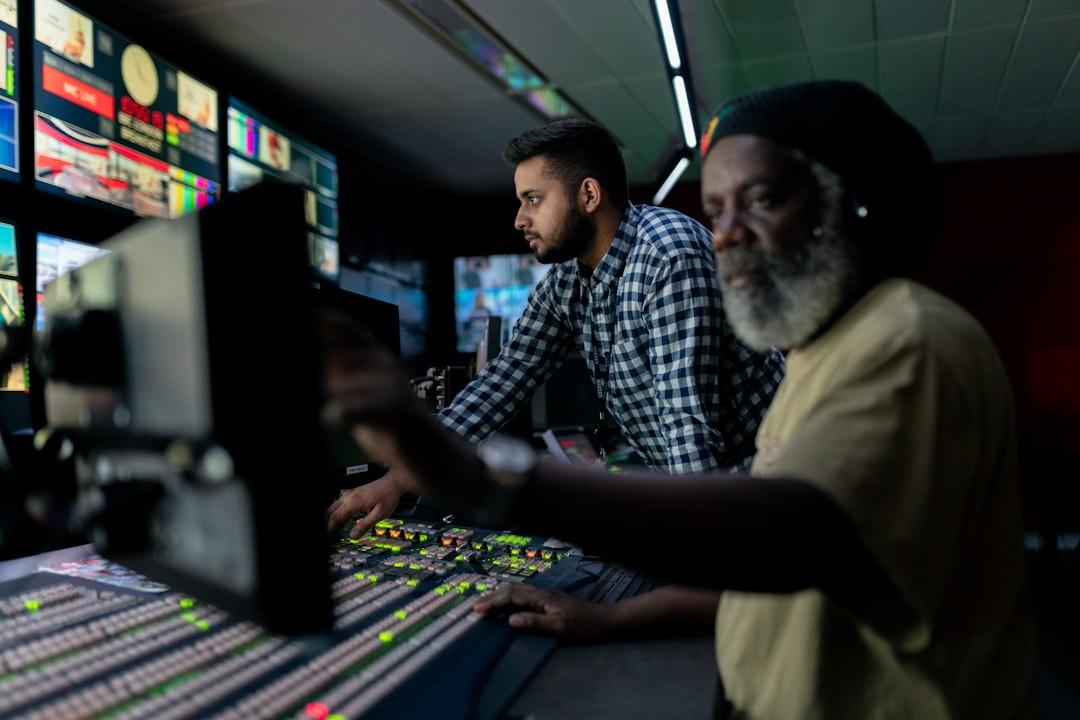
A hybrid event is bi-directional. Remote attendees can ask questions, vote in polls, join breakout sessions, and engage with speakers in real time. The run-of-show is built with two audiences in mind from the start, not bolted on at the end. That requires a separate directorial layer, someone managing the online experience independently of what's happening on the physical stage.
The practical implication: a hybrid event costs more, takes more coordination, and demands more from your production partner. That's not a reason to avoid it. It's a reason to be honest about whether you need it.
When does a livestream give you everything you need?
Livestreaming is the right choice when your primary goal is reach and information delivery, not participation. For many corporate formats, that's exactly what's required.
Consider a CEO quarterly update for 800 employees spread across three countries. The message is consistent, the format is broadcast-style, and the audience needs to receive information clearly, not co-create it. A professional livestream from our webinar studio in Zaventem, with multicam direction, clean audio, branded graphics, and a live Q&A module at the end, delivers that experience at a fraction of the complexity of a full hybrid setup.
Livestreaming works well when:
- You have one central message to deliver
- The audience is large and geographically dispersed
- Interaction is limited or can be handled through a simple Q&A or chat
- The physical experience isn't a core part of the value
- Budget and operational complexity need to stay manageable
- Your internal IT team can't support a complex dual-stream infrastructure on the day
A tightly produced livestream, with proper redundancy, a professional encoder, and CDN delivery, is not a compromise. It's a deliberate choice that often outperforms a poorly executed hybrid event. We've seen organisations spend three times the budget on a "hybrid" townhall where the online stream was essentially an afterthought, while a focused livestream production would have served their remote audience far better.
For events where broadcast quality is non-negotiable, our on-site live streaming service includes redundant internet connections, multicam direction, and full post-production — specifically so technical failure during a CEO keynote isn't something your team has to worry about.
When does hybrid genuinely add value?
Hybrid earns its complexity when both your physical and digital audiences are strategically important, and when treating one as secondary would undermine the event's purpose.
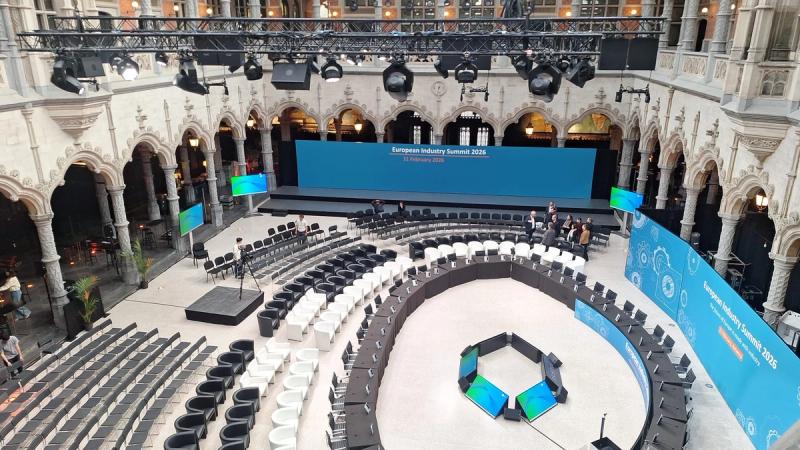
The clearest signal that hybrid is right: you have two distinct audiences with different needs, and both matter equally. A product launch where 200 clients attend in Brussels and 500 partners dial in from across Europe. A shareholder meeting where presence in the room carries legal weight but remote participation is expected. A leadership forum where the conversation itself, not just the content, is the deliverable.
In these situations, the online experience needs its own production logic. That means a dedicated director managing the digital stream, interactive elements built into the platform, and a run-of-show that accounts for both audiences simultaneously. It's not enough to point a camera at the stage and call it hybrid.
Hybrid is the right call when:
- Physical attendance and digital participation are both central to the event's value
- You want remote attendees to ask questions, vote, and engage, not just watch
- The event has multiple sessions or tracks that need to be managed across both environments
- Networking or relationship-building is part of the programme
- The event carries brand weight that demands a polished experience for every attendee, regardless of location
- You're trying to reduce travel costs without reducing the quality of the experience for remote participants
Our approach to corporate hybrid events is built around a single directorial vision for both audiences. There's no split production, no compromise — the physical stage and the digital stream are managed as one coherent broadcast. That's what prevents the "second-class" experience that remote attendees so often report.
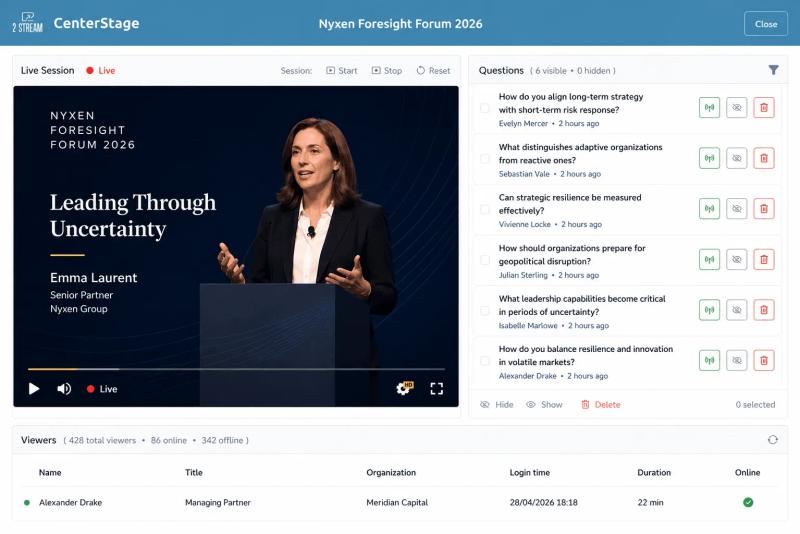
For organisations running recurring high-stakes broadcasts — investor calls, executive forums, quarterly townhalls — CenterStage gives you a dedicated platform built for exactly this: branded landing pages, live Q&A moderation, session management, and full streaming infrastructure in one operational dashboard. It's how you run a professional broadcast without rebuilding the infrastructure every time.
The mistake most event managers make
The most common error we see is defaulting to hybrid because it sounds more comprehensive. Organisations that ran fully virtual events during 2020–2021 have overcorrected, assuming that any event with remote attendees must be hybrid.
The result is often a physical event with a livestream bolted on, which is neither a good hybrid event nor a clean livestream. The in-room audience gets the full experience. The remote audience gets a wide-angle camera shot and audio that drops whenever someone moves away from the microphone. That's not hybrid. That's a missed opportunity.
The right question isn't "hybrid or livestream?". It's "what does each of my audiences actually need, and what's the minimum format that delivers that fully?"
If your remote audience needs to participate, invest in hybrid. If they need to receive and absorb, invest in a production-quality livestream. Either way, production quality has to be there — because a glitch during your CFO's presentation to shareholders reflects on the company, not on the vendor.
For more on how event technology choices are evolving, our guide to hybrid event trends in 2026 covers where AI, interaction design, and ROI measurement are heading. And if you're thinking through platform options for enterprise-scale broadcasts, our breakdown of enterprise webinar software for live and hybrid events gives you a clear picture of what to look for.
How to choose: a quick decision framework
Ask yourself these four questions before committing to a format:
- Participation or broadcast? If remote attendees need to actively participate, hybrid. If they need to receive a message clearly, livestream.
- One audience or two? If both physical and digital audiences are strategically equal, hybrid. If the physical event is primary and digital is supplementary, livestream.
- Interaction or information? If Q&A, polls, and breakout sessions are central to the value, hybrid. If a live Q&A module at the end is sufficient, livestream.
- Budget and complexity? Hybrid requires more investment in production, platform, and coordination. Only invest that if the return — in engagement, reach, and audience experience — justifies it.
The format decision is a strategic choice, not a technical one, and getting it right means your production budget goes where it actually moves the needle. With this framework, you can stop defaulting to hybrid out of habit and start choosing the format that genuinely serves your audience. If you're ready to talk through your next event, get in touch with the 2 Stream team to discuss which format fits your situation and what a professional production looks like in practice.
Frequently asked questions
What is the difference between a hybrid event and a livestream?
A livestream broadcasts content from a physical location to a remote audience in a one-directional format. A hybrid event gives the remote audience their own interactive experience, with live Q&A, polls, and session participation built in from the start. The key distinction is whether the online audience watches or actively participates. Hybrid requires a separate production layer managing the digital experience independently of the physical stage.
What are the benefits of hybrid events?
Hybrid events allow you to serve two distinct audiences simultaneously without forcing one to compromise. Physical attendees get the in-room experience, while remote participants engage through interactive tools rather than passive viewing. Benefits include wider reach, reduced travel costs for remote attendees, built-in data collection on engagement, and the ability to run multi-track sessions across both environments. The value is highest when both audiences are strategically important to the event's outcome.
What are the cons of hybrid events?
Hybrid events are significantly more complex and expensive than either a standalone physical event or a clean livestream. They require dedicated production for both audiences, a more involved run-of-show, and a platform that handles interactivity reliably. The biggest risk is executing hybrid poorly: a physical event with a camera pointed at the stage creates a worse experience than a well-produced livestream would have. Hybrid only earns its cost when both audiences are treated with equal production intent.
When is livestreaming a better choice than hybrid?
Livestreaming is the better choice when your primary goal is delivering a clear message to a large, dispersed audience and interaction is limited or optional. Townhalls, CEO updates, product announcements, and compliance broadcasts are often better served by a high-quality livestream than by a hybrid setup. A professional livestream with redundant connectivity, multicam direction, and clean audio delivers a reliable, scalable experience without the operational complexity of managing two simultaneous audience journeys.
What is the difference between a hybrid event and a virtual event?
A virtual event has no physical component at all — every attendee participates online. A hybrid event combines a physical gathering with a digital participation layer, running both simultaneously. Virtual events are fully platform-dependent and require no on-site production crew. Hybrid events require on-site production for the physical audience and a separate digital production layer for remote participants. The choice between them depends on whether in-person attendance is a core part of the event's value.
How do you make remote attendees feel as engaged as those in the room?
The answer is treating the online experience as a first-class production, not an add-on. That means building the run-of-show with remote attendees in mind from the start, using a platform with live Q&A and polling built in, assigning a dedicated director for the digital stream, and ensuring audio and video quality match what the in-room audience receives. Remote attendees feel disengaged when they're an afterthought. They feel engaged when the production was designed with them in mind.
Let's talk about your event
Tell us the date and the format. We will tell you what it takes and what it costs.