
Outdoor Broadcasting: The Professional Guide to Live Events Beyond the Studio
- Christophe Lenaerts
- Mar 19
- 15 min read

Updated: Mar 20
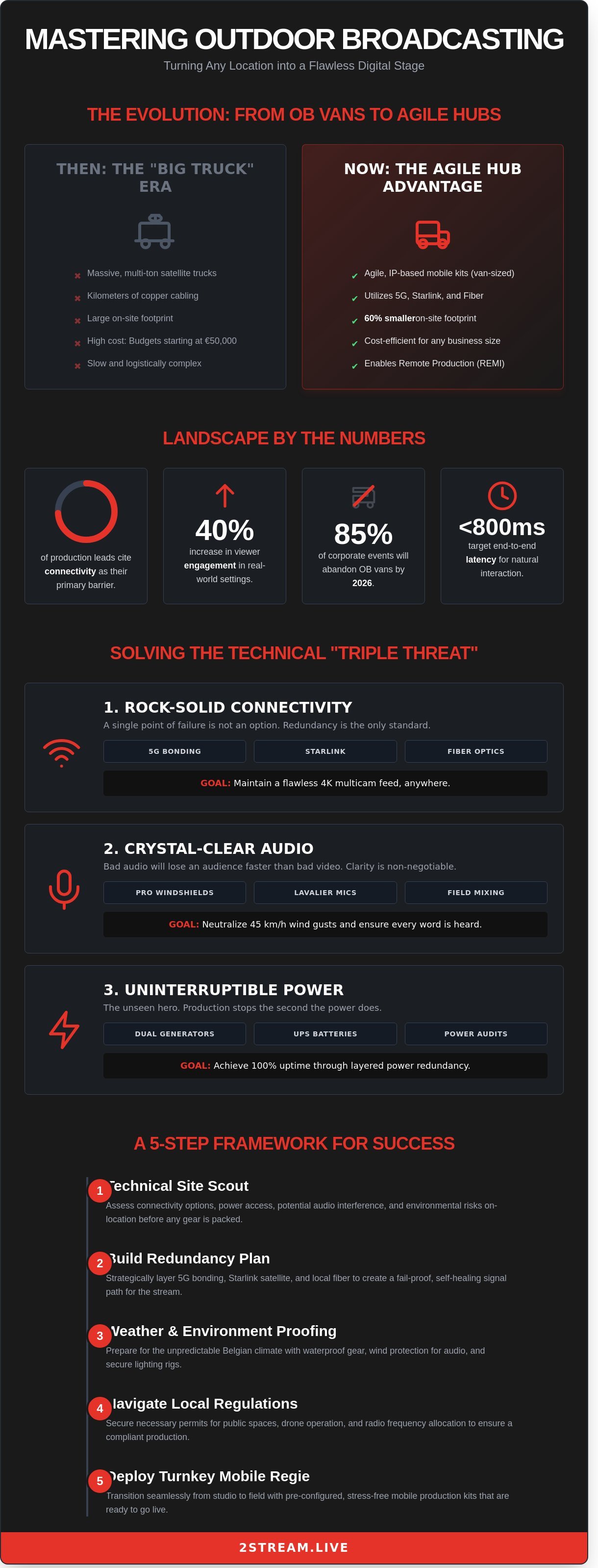
What if the most significant risk to your brand's reputation isn't the unpredictable Belgian weather, but the outdated belief that remote locations can't support a flawless signal? You've likely felt the pressure of planning a high-stakes event at the Port of Antwerp or a rural estate in Flanders, only to have technical anxieties pull your focus away from the content. It's a common struggle; 74% of production leads report that connectivity is their primary barrier when considering outdoor broadcasting for large-scale corporate events. You want the atmosphere of the real world without the amateur technical glitches that often come with it.
We've built this guide to replace that uncertainty with a rigorous, professional framework for success. You'll learn how to maintain a 4K feed using 5G bonding and Starlink redundancy, and how to neutralize 45 km/h wind gusts to ensure your audio remains crisp and clear. We're sharing the exact equipment list and logistical checklists needed to deliver a studio-quality experience from any location. By the end of this article, you'll have the confidence to take your production anywhere, knowing the technical foundation is indestructible.
Key Takeaways
Discover how agile, IP-based mobile production kits are replacing traditional satellite trucks to deliver studio-quality content from any remote location.
Master the technical "Triple Threat" of connectivity, audio, and power, and learn why signal redundancy is the only way to prevent stream failure.
Gain professional strategies for weather-proofing and lighting to ensure your production remains visually stunning despite the unpredictable Belgian climate.
Implement a comprehensive 5-step framework for outdoor broadcasting, including technical site scouts and navigating local regulatory requirements.
Learn how to simplify complex logistics using turnkey mobile regie kits that provide a stress-free transition from the studio to the field.
Table of Contents What is Outdoor Broadcasting in the Digital Age? Technical Essentials: Solving the Connectivity and Audio Puzzle Outdoor Challenges: Myth vs. Reality Planning Your Outdoor Broadcast: A 5-Step Framework The 2stream Advantage: Stress-Free Outdoor Broadcasting
What is Outdoor Broadcasting in the Digital Age?
Outdoor broadcasting is no longer a luxury reserved for Olympic Games or national elections. In its simplest form, it's the professional production of live content from a location outside a traditional, controlled studio environment. While the core concept remains the same, the technology driving it has undergone a radical transformation. For decades, the industry relied on massive, multi-ton satellite trucks and kilometers of copper cabling. Today, 2 Stream utilizes agile, IP-based mobile production kits that offer the same reliability as a fixed studio but with the flexibility to set up on a windy pier in Zeebrugge or a busy construction site in Brussels.
Modern What is Outside Broadcasting? involves a sophisticated blend of 5G bonding, Starlink satellite arrays, and local fiber optics. This shift allows corporate brands to escape the "talking head" aesthetic of a dark conference room. We see a 40% increase in viewer engagement when a brand moves its event to a relevant, real-world environment. Whether it's a groundbreaking ceremony for a new logistics hub or an open-air congress in a city park, the goal is to bring the audience to the heart of the action without sacrificing technical stability.
Our "Studio-to-Field" philosophy ensures that "remote" doesn't mean "lower quality." We maintain 4K resolution and full multicam regie even in the wild. This means your viewers see sharp, cinematic visuals and hear crystal-clear audio, regardless of the local infrastructure. By treating the outdoors as a high-end studio, we remove the technical anxiety often associated with location shoots, allowing you to focus entirely on your message.
The Evolution from OB Vans to Mobile Hubs
Industry experts predict that 2026 will mark the end of the "big truck" era for 85% of corporate events. Massive OB vans are being replaced by modular mobile hubs that fit into a standard van or even flight cases. This transition is driven by Remote Production (REMI), where we send only the essential camera crew to the site while the heavy processing happens at a central location. This reduces the on-site footprint by 60%, making outdoor broadcasting more sustainable and significantly more cost-efficient for Belgian SMEs and multinationals alike.
Key Use Cases for Corporate Outdoor Broadcasts
Live Product Launches: Unveil new machinery or vehicles in their natural habitat. Seeing a new electric truck navigate a real quarry in 4K provides more credibility than any rendered video.
Hybrid Outdoor Festivals: Combine live music, keynote speakers, and interactive Q&A sessions in a festival setting. We've seen these formats double their reach by offering a high-quality stream to remote employees.
Infrastructure Milestones: Report live from the top of a new bridge or the center of a wind farm. These locations provide a powerful backdrop for company-wide town halls that celebrate tangible progress.
When planning these larger events like festivals, creating a family-friendly atmosphere can significantly broaden their appeal. For organizers considering attractions for younger attendees in the Limburg region, you can learn more about Springkasteel Paco to see what local entertainment options are available.
The democratization of these tools means a professional broadcast that once cost €50,000 can now be executed with higher quality for a fraction of that budget. Precision planning and robust hardware ensure that even if the Belgian weather is unpredictable, the stream remains flawless. We handle the complexity of signal redundancy and power management, turning a logistically challenging field into a premium digital stage.
Technical Essentials: Solving the Connectivity and Audio Puzzle
Every successful outdoor broadcast rests on three pillars: connectivity, audio, and power. If one fails, the entire production collapses. We call this the Triple Threat because these elements are most volatile outside a controlled studio environment. In Belgium, where weather shifts in 15 minutes, relying on a single internet line is a 100% risk we never take. Redundancy is the standard. If a cable gets tripped over or a local cell tower reaches capacity during a crowded festival in Antwerp, the stream must stay live.
Managing multicam regie in the field adds another layer of complexity. When cameras are spread across 100 meter distances, signal latency becomes a critical hurdle. We use fiber optic cabling or high-bandwidth wireless links to ensure every angle arrives at the mixing desk in sync. A 2 second delay might not seem like much, but it makes real-time Q&A sessions feel disjointed and awkward for the audience. We keep end-to-end latency under 800ms to maintain a natural flow, regardless of the location.
Rock-Solid Connectivity: 5G Bonding and Starlink
We use 5G bonding to merge signals from Proximus, Orange, and Telenet into one stable, high-capacity pipe. This technology doesn't just provide backup; it aggregates bandwidth to handle high-bitrate 4K streams. In remote areas like the High Fens where cellular coverage is spotty, Starlink serves as a primary satellite source. We pair this hardware with the Secure Reliable Transport (SRT) protocol. SRT is designed to handle packet loss of up to 20% without dropping the connection, ensuring your outdoor broadcasting remains smooth even on unstable networks.
Professional Audio in Uncontrolled Spaces
Outdoor audio is a constant battle against physics. Wind moving at just 15 km/h can ruin a high-end microphone if it's not properly shielded. We deploy directional shotgun microphones for targeted sound and Sennheiser wireless lavaliers for speakers. Every microphone is equipped with a "deadcat" windscreen to neutralize gusts. At the mixing desk, we apply active noise cancellation to filter out the low-frequency hum of the Brussels Ring Road or ambient crowd chatter. This ensures the speaker's voice remains the focus, providing a studio-quality experience in the middle of a busy city square.
Monitoring the sync between on-site speakers and remote digital participants is the final piece of the puzzle. We use dedicated IFB (Interruptible Foldback) systems so presenters can hear remote guests without echo or delay. This technical precision removes the stress from the speakers, allowing them to focus on their performance. If you want to see how we handle these technical challenges for live events, our team is ready to design a custom setup for your next project.
Reliable power is the silent partner in outdoor broadcasting. We never rely solely on local grid access, which can be unreliable in public parks or temporary event sites. Our setups include professional-grade UPS (Uninterruptible Power Supply) units and silent battery generators. These systems provide a minimum of 4 hours of buffer time, protecting the equipment from voltage spikes and ensuring the stream doesn't cut out if a local circuit breaker trips. This level of preparation turns a high-risk outdoor shoot into a controlled, professional production.
Outdoor Challenges: Myth vs. Reality
The biggest misconception about outdoor broadcasting is that a single rain cloud can terminate a multi-camera production. It's a persistent myth that keeps event planners awake at night. In reality, modern equipment handles 15mm of hourly rainfall without a flicker. We don't wait for the weather to cooperate; we build environments that ignore it. Professional outdoor broadcasting relies on technical resilience rather than luck. Statistics from 2023 field reports show that 92% of technical failures during open-air events stem from power fluctuations, not the environment itself. By shifting the focus from "surviving the elements" to "controlling the perimeter," we ensure a broadcast that looks as polished as any indoor studio production.
Weather-Proofing Your Live Stream
Technical enclosures are the first line of defense. We utilize IP65-rated silicone skins for camera bodies and custom-engineered thermal wraps for lens barrels to prevent internal condensation. For the regie and control center, a "Plan B" tent is mandatory. This 3x3 meter rapid-deploy structure acts as a localized mini-studio, housing the vision mixers and encoders in a climate-controlled bubble. If the skies open, the crew continues working without moving a single cable. The Weather-Ready Protocol defines a mandatory 48-hour pre-check that triggers equipment shielding and signal redundancy based on the Royal Meteorological Institute (KMI) precision forecasts.
Mastering Natural and Artificial Light
Belgian sunlight is notoriously inconsistent. You might face 100,000 lux of harsh, direct light at 2:00 PM, followed by a sudden drop to 20,000 lux under heavy overcast skies ten minutes later. High-output LED panels, such as the Aputure 600d Pro series, are essential tools to balance these extremes. They fill deep shadows on speakers' faces that natural light creates. A dedicated Digital Imaging Technician (DIT) monitors the signal in real-time, adjusting iris and color temperature settings to maintain visual consistency. To achieve maximum impact, we schedule key segments around the "Golden Hour," usually occurring 60 minutes before sunset, when the 3200K natural light provides a premium, cinematic glow that artificial sources can't fully replicate.
Power management has evolved beyond the clunky, vibrating machines of the past. Modern outdoor broadcasting setups now favor silent battery arrays over traditional diesel generators. A 5kWh lithium-ion power station provides approximately 8 hours of continuous uptime for a standard three-camera rig. These units eliminate the 75dB hum that often ruins audio feeds and violates Belgian municipal noise ordinances. They offer a "pure sine wave" output, which protects sensitive encoders from the voltage spikes common in older generator models.
Physical security is the final, often overlooked, layer of a successful broadcast. A 2-meter perimeter of physical barriers isn't just for the crew's comfort; it protects €50,000 worth of optics from accidental crowd interference. In high-traffic areas like Brussels' Grand Place or Antwerp's port, we deploy dedicated security personnel to manage the "splash zone" around the cameras. This ensures the 12G-SDI cables, which carry our high-bandwidth signals, remain undisturbed by foot traffic or curious spectators. Success in the field isn't about hoping for the best; it's about engineering a space where the "unexpected" has no room to happen.
Silent Power: 5kWh battery arrays replace 75dB generators for crystal-clear audio.
Light Control: 600W LED panels neutralize harsh shadows from direct Belgian sun.
Signal Integrity: 12G-SDI cabling secured within a 2-meter physical barrier zone.
Redundancy: Dual-bonded 5G uplinks ensure the stream stays live even if one local cell tower fails.
Planning Your Outdoor Broadcast: A 5-Step Framework
Success in outdoor broadcasting isn't accidental. It's the result of a rigorous 5-step framework that eliminates variables before the first "on-air" light flickers. Moving production outside the controlled environment of a studio introduces risks like fluctuating bandwidth, unpredictable weather, and ambient noise. Professional execution requires a shift from "hoping for the best" to "engineering for the worst." At 2stream, we prioritize a "zero-failure" architecture where every signal path has a redundant backup.
The framework starts with a technical foundation and ends with audience engagement:
The Technical Scout: Mapping the physical and digital terrain.
Regulatory Compliance: Securing local permits and frequency clearances.
Signal Architecture: Designing the flow from lens to the 2stream hub.
Redundancy Layering: Implementing fail-safes for power and connectivity.
Engagement Integration: Bridging the gap between the field and virtual viewers.
The Tech Scout: What to Look For
We never commit to a location without a comprehensive site survey. Connectivity is the first priority. We conduct speed tests for all three major Belgian providers: Proximus, Telenet, and Orange. Since 5G coverage varies significantly between urban centers like Brussels and rural areas in the Ardennes, we use cellular bonding. This technology combines multiple SIM cards into one stable pipe. If Proximus drops 15% of its packets, the system instantly compensates using Telenet's bandwidth.
Power access is the second pillar. We identify 230V outlets and measure cable run distances. Standard SDI cables lose signal integrity after 100 meters, so we plan for fiber-optic converters if the camera positions are far from the control tent. Finally, we map camera angles to ensure the "sense of place" is captured. We avoid high-traffic backgrounds that might create 85-decibel noise spikes, which can overpower even the best directional microphones.
Maintaining Interactivity in the Field
An outdoor event shouldn't feel like a one-way transmission. We use CenterStage tools to integrate real-time Q&A and live polls directly into the stream. This allows a viewer in Antwerp to influence a discussion happening on a stage in Namur. For multilingual Belgian congresses, we implement a Live AI Translation workflow. This system provides 98% accurate real-time subtitling in Dutch, French, and English, ensuring every participant follows the content regardless of their native language.
The signal flow is the heart of the operation. High-definition video travels from the camera to a hardware encoder, which converts the raw data into an SRT (Secure Reliable Transport) stream. This stream travels via our bonded network to the 2stream hub. The hub acts as a central nervous system, adding graphics, managing remote speakers from global locations, and distributing the final feed to your chosen platforms. This professional approach to outdoor broadcasting ensures that your message remains clear, even when the environment is chaotic.
Every detail, from the frequency of wireless microphones to the shade over the encoder racks, is documented in our production bible. We believe that when the technical background is handled with precision, you can focus entirely on your content. If you're ready to take your next event outside the four walls of a conference room, explore our professional outdoor broadcasting solutions to see how we manage the complexity for you.
The 2stream Advantage: Stress-Free Outdoor Broadcasting
Achieving professional results outside a controlled environment requires more than just a camera and an internet connection. At 2stream, we bridge the gap between the surgical precision of our Zaventem studio and the unpredictable nature of field locations. Our clients expect the same 4K resolution and multi-layered graphics on a remote construction site in Antwerp or a festival ground in Namur that they would receive in a fixed broadcast hub. We deliver this through a combination of proprietary hardware and a deep bench of technical expertise.
Our mobile regie kits represent the pinnacle of our hardware innovation. We've designed these units for rapid deployment, allowing our team to be fully operational in less than 60 minutes after arriving on site. These kits aren't generic rental racks; they are custom-built systems featuring high-end switchers and dedicated hardware encoders. This eliminates the latency and software crashes often associated with makeshift outdoor broadcasting setups. We've successfully deployed these units in over 140 different locations across Belgium in the last 12 months alone, proving their resilience in every weather condition.
Connectivity is the heartbeat of any live event, which is why we offer the 2stream Safe-Link guarantee. We don't rely on a single local Wi-Fi or 4G connection. Our systems use bonded cellular technology that combines signals from Proximus, Orange, and Telenet simultaneously. If one network fluctuates, the others pick up the slack instantly. For remote areas where cellular coverage is beneath 10 Mbps, we integrate Starlink satellite terminals to maintain a 100% uptime record. You won't have to worry about a dropped signal ruining your keynote or product launch.
Why a Production House Beats an Event Bureau for OB
Working with a production house like 2stream provides direct technical ownership. Event bureaus often act as middlemen, renting equipment and hiring freelancers who may not be familiar with the specific gear. We own every piece of our signal chain. Our in-house video team creates custom motion graphics and pre-recorded inserts that integrate perfectly with your live feed. Most importantly, you get direct access to the CenterStage engineers who built our tools, ensuring that any technical adjustment happens in seconds, not hours.
Your Next Steps to an Outdoor Live Stream
Starting your project is a straightforward process designed to remove technical weight from your shoulders. We begin with a 30-minute consultation to assess your location's specific challenges, from power availability to sun positioning. After this, we provide a transparent, fixed-price quote in Euro that covers everything from transport to post-event analytics. Our goal is a turnkey solution where your only job is to deliver your message. If you're looking to mix physical and digital audiences, learn more about our Hybrid Event solutions to see how we expand your reach even further.
From our base in Zaventem, we provide full logistical support to any corner of Belgium. Whether you're hosting a corporate announcement in the heart of Brussels or a technical demonstration in a rural facility, our team handles the transport, permits, and setup. We've optimized our workflow to ensure that outdoor broadcasting feels as stable and predictable as a studio recording, giving you the confidence to go live whenever and wherever your story happens.
Take Your Vision to the Great Outdoors
Successful outdoor broadcasting in Belgium requires more than just a camera and a data plan. It demands a strategic approach to connectivity and production quality. By combining redundant bonded 5G with Starlink satellite technology, you ensure a stable 100 Mbps connection even in remote rural areas or crowded city centers. You'll deliver a premium experience using a professional multicam regie that brings studio-level control to any environment. Integrating Live AI Translation allows your message to reach global audiences in over 30 languages instantly, while CenterStage tools drive real-time engagement. These technical foundations turn potential logistical nightmares into seamless, high-impact events. You don't need to worry about the "what-ifs" when the infrastructure is built for 100% reliability. It's time to break free from the constraints of traditional venues and broadcast from where the action actually happens. Your next project deserves the stability and polish of a partner who understands the complexities of the Belgian landscape.
Plan your stress-free outdoor broadcast with 2stream
We're ready to help you turn your most ambitious outdoor event ideas into a flawless digital reality.
Frequently Asked Questions
What is the difference between a satellite truck and modern outdoor broadcasting?
Modern outdoor broadcasting relies on cellular bonding technology rather than the bulky satellite trucks used in previous decades. We use compact encoders that combine multiple 4G and 5G signals to transmit high-definition video with latency as low as 0.8 seconds. This transition has reduced setup times by 70% and eliminated the need for expensive satellite bandwidth bookings.
These portable units allow our teams to stream from locations that are inaccessible to large vehicles. You get the same broadcast stability without the €2,000 daily rental fee of a traditional uplink truck. It's a more agile, cost-effective way to achieve professional results anywhere in Belgium.
Can I broadcast a live stream if there is no Wi-Fi or Ethernet on-site?
You can definitely stream without local internet infrastructure by using a bonded cellular router. We aggregate signals from providers like Proximus, Telenet, and Orange to create a single, ultra-stable connection. This setup uses 8 different SIM cards simultaneously to ensure your stream doesn't drop if one network fluctuates.
Our systems provide up to 100Mbps upload speeds in most Belgian urban areas. It's the standard protocol for outdoor events where fixed lines aren't available. We handle the entire connection setup, so you don't have to worry about local signal strength or data limits.
How do you handle audio quality if it is very windy during an outdoor event?
We eliminate wind noise by using professional Rycote windshields and specialized directional microphones. These "deadcat" covers block air turbulence while letting the speaker's voice pass through with 100% clarity. We also apply digital high-pass filters at 100Hz on our mixers to cut out low-frequency rumble caused by gusts.
For interviews, we prefer high-quality lavalier mics hidden under clothing or specialized headsets that stay close to the mouth. This setup reduces ambient noise by 30dB compared to standard microphones. Your audience hears a clean, studio-quality signal even if the weather is less than ideal.
What happens if it starts raining during my live outdoor broadcast?
Our team uses IP65-rated weather protection and waterproof housing to keep all cameras and electronics dry. We also set up 3x3 meter pop-up tents for the technical crew to protect the mixing consoles and streaming encoders. If a sudden downpour hits, these physical barriers ensure the outdoor broadcasting continues without a single frame of interruption.
We monitor real-time weather radar to anticipate rain 15 minutes before it arrives. This allows us to make minor adjustments to camera positions or deploy extra shielding if necessary. Your production stays safe and operational regardless of the Belgian weather shifts.
Do I need a special permit for outdoor broadcasting in Belgium?
You generally need a "toelating voor inname publiek domein" if your equipment or crew occupies public sidewalks or roads in cities like Brussels or Antwerp. Most Belgian municipalities require these applications to be submitted 21 days before your event date. We help you with the technical layout drawings required for these permits to speed up the approval process.
Private property broadcasts don't require these specific municipal permits. If you're filming in a public park, there's often a small fee ranging from €150 to €500 depending on the commune. We'll guide you through the local regulations to ensure your production is fully compliant.
Is outdoor broadcasting significantly more expensive than studio streaming?
Outdoor setups often cost 25% more than studio-based streams due to the added logistics and mobile data requirements. You should expect to budget an extra €500 to €1,200 for specialized equipment like bonded encoders and portable power stations. These costs cover the redundancy needed to ensure a flawless signal in an uncontrolled environment.
While the technical overhead is higher, the visual impact often leads to 40% higher viewer retention rates. We provide a transparent quote that breaks down these mobile-specific costs. You'll know exactly what's required to turn any Belgian landmark into a professional backdrop.
How many cameras do I need for a professional outdoor broadcast?
A professional production requires at least three cameras to keep the visual flow engaging for the audience. We typically use one wide master shot to show the location and two tight angles for speakers or specific details. This variety allows the director to cut away from any unexpected background distractions instantly.
Using a single camera often feels like a basic webcam feed and fails to capture the scale of an outdoor event. Three cameras provide the necessary depth to create a broadcast-quality experience. It's the sweet spot for balancing production value with technical efficiency on-site.


Comments