
AV production for government and EU institutions in Brussels

If your event involves EU institutions, embassies, or government stakeholders, you don't need an event agency with an AV add-on. You need a specialist who treats protocol, security and failover as the job, not an afterthought.
Most AV providers listed for Brussels position themselves as general technical suppliers: sound, lighting, LED screens, staging. That's fine for a product launch or a corporate away-day. It's not what a Council working group, a NATO-adjacent conference, or an embassy public diplomacy event actually requires. We see this constantly in our work with communications directors and public affairs managers: they've been burned once by a supplier who could rig a screen but couldn't run a bilingual livestream failover when a router dropped mid-session, and they're done taking that risk twice.
This article makes the case for treating "AV for government and EU institutions" as its own category, with its own selection criteria, not a subset of general event production.
Why generalist AV providers fall short for EU institutional events
Generalist AV suppliers optimize for equipment delivery, not for the operational discipline that institutional events demand. Brussels has no shortage of companies offering sound, lighting and screens for conferences. What's harder to find is a partner who's built their process around simultaneous interpretation booths, multi-language livestreams, credentialed access zones and a run-of-show that survives a protocol change ninety minutes before doors open.
The market signal is clear if you look at how providers describe themselves. Several Brussels-based AV companies market lighting, LED walls and "full technical production" as their headline offer. That's a rental-and-rigging value proposition. It says nothing about how they handle a Commission spokesperson's last-minute request to add a second interpreted language feed, or what their contingency plan is when a delegation's press office needs an isolated, embargoed recording of one panel only.
Institutional events carry constraints that a standard corporate brief doesn't:
Protocol sequencing (who speaks when, in what order, filmed from which angle) that can't be improvised
Security-cleared crew and equipment for venues with access control
Multi-language production, often with simultaneous interpretation feeds that must sync perfectly with the video output
Zero tolerance for dead air on a livestream watched by press, embassies or oversight bodies
Confidentiality requirements for closed sessions, off-the-record segments, or embargoed content
A supplier who's never worked a room with these rules will discover them live, in front of your stakeholders. That's the risk you're actually pricing when you compare quotes.
What "mission-critical" actually means for government AV
Mission-critical AV means the production has no acceptable failure mode, not just a "we'll try our best" service level. For a defence conference, an EU Council side event, or an embassy's public affairs livestream, a dropped stream or a garbled interpretation feed isn't an inconvenience. It's a diplomatic incident, a headline, or a compliance problem.
In our engagements across NATO-ecosystem events, EU institutional settings and public affairs conferences, the recurring failure point isn't the camera or the screen. It's the network path and the redundancy plan behind the livestream. When we run technical site assessments for institutional clients, the first question is never "what camera package do you want" but "what happens the moment your primary connection fails, and does your audience ever know it happened." That's the standard institutional buyers should be holding every AV partner to.
This is where our approach to professional livestreaming for events and congresses differs from a generalist rental model: redundant connectivity, on-site technical assessment before the event, and a crew that's run enough high-stakes rooms to know where things break. You don't build that discipline doing weddings and product launches. You build it doing summits, ministerial panels and embassy briefings, repeatedly, under real pressure.
The Brussels factor: multilingual, multi-stakeholder, multi-format
Brussels adds a layer no other European city replicates at the same density: institutional multilingualism combined with transatlantic stakeholder traffic. A single event here can involve Commission officials speaking French, a NATO representative speaking English, a national delegation speaking Dutch or German, and a Washington-based partner joining remotely. Your AV partner needs to handle all of that as one coherent production, not as four separate technical problems bolted together.
This is precisely the ground we operate on. Organizations running hybrid event production for international organizations in Brussels need a partner comfortable coordinating in-room interpretation, multi-camera capture, and a remote audience spread across time zones, all inside one run-of-show. Our work on the USA250 celebration broadcast from Brussels to a global audience is a direct example: a transatlantic audience, institutional protocol, and a live broadcast that had to hold up in real time with no second take.
If your organization operates between Brussels and Washington DC, the AV partner question isn't hypothetical. It's operational. You need someone who has actually coordinated a feed across that specific axis before, not someone quoting a generic international capability.
Choose a specialist AV partner if... skip it if...
Choose an institutional AV specialist when the event carries reputational, diplomatic or security weight that a technical failure would directly damage. Skip the specialist premium only when the event is genuinely low-stakes and internal.
Choose a specialist partner if:
The audience includes EU officials, embassy staff, defence stakeholders, or press
The event is livestreamed to external or remote stakeholders who can't be re-invited if the feed drops
You need simultaneous interpretation synchronized with video and streaming output
The venue has security or access-control requirements
You're running a hybrid format spanning Brussels and international offices simultaneously
A single AV misstep would generate press coverage or stakeholder complaints
Skip the specialist route (a smaller, general AV rental will do) if:
It's a fully internal, single-language meeting with no external audience
Nothing is being recorded, streamed, or archived for compliance or communications purposes
The room is small, informal, and there's no protocol sequencing involved
Most institutional communications teams already know which category their event falls into. The mistake is treating a genuinely mission-critical event like a low-stakes one to save on the AV line item, then discovering the gap on the day.
Addressing the real objections
"We already have an event agency, why add an AV production partner?" Because an event agency manages logistics, catering, and guest experience. It rarely owns the technical direction, streaming infrastructure and failover planning that institutional AV requires. The two roles complement each other; they don't overlap. We regularly work alongside event and public affairs agencies as the technical production layer underneath their event management.
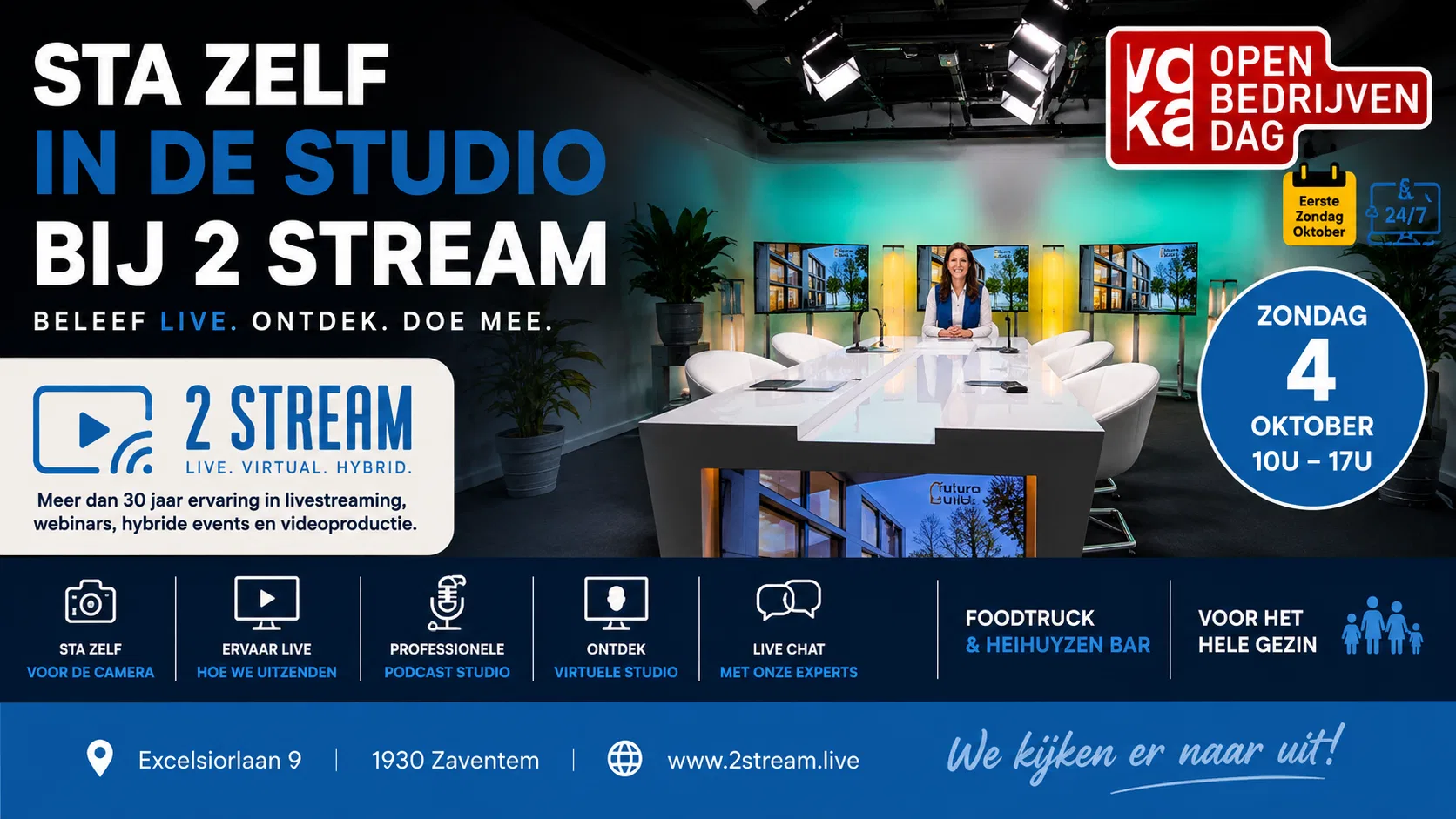
"Our IT department says we can stream this ourselves via Teams or Zoom." Consumer conferencing tools were built for internal meetings, not for a multi-camera, multi-language, public-facing broadcast with redundant connectivity and professional visual quality. For an internal town hall, Teams is fine. For a ministerial panel watched by press and embassies, it isn't the same risk category. The webinar studio in Brussels exists precisely for the gap between "we can technically stream this" and "this needs to look and perform like an institutional broadcast."
"This seems expensive compared to what we could do in-house." Compare it against the cost of a failed livestream in front of an EU or diplomatic audience, not against a Teams license. Institutional reputational risk doesn't show up on the invoice, but it shows up in the aftermath.
Frequently asked questions
How do we find a professional company for our corporate event livestream in Brussels?
Look for a provider who can show direct experience with institutional, government or EU-context events, not just corporate conferences. Ask for references in defence, public affairs or embassy settings specifically. Confirm they handle technical direction, redundant streaming infrastructure and on-site crew, not just equipment rental.
How do we organize a hybrid event for remote employees or stakeholders?
Start with a technical site assessment of your venue's connectivity and layout, then build a run-of-show that treats the remote audience as a first-class participant, not an afterthought. Our hybrid events service covers live direction and digital experience management so in-person and remote audiences get equivalent quality.
Can government or EU events be livestreamed securely?
Yes, with redundant connectivity, access-controlled production zones, and a crew briefed on confidentiality requirements. Security-sensitive institutional events routinely combine livestreaming with closed or embargoed segments, handled through careful pre-production planning rather than improvisation on the day.
What happens if the technology fails during a live broadcast?
A properly built institutional AV setup includes redundant network paths and backup equipment specifically so a single failure doesn't take the broadcast down. The real question to ask any AV partner is what their specific failover plan is, not whether failure is possible.
We only have a small budget for this event. Is specialist AV still worth it?
Scale the production to the stakes, not the budget alone. A smaller institutional session with a handful of officials still needs reliable interpretation sync and stream stability; it just needs a leaner crew and setup, not a lesser standard of reliability.
Institutional AV in Brussels is a distinct discipline, not a bigger version of corporate event production. Knowing that changes how you write the brief, who you shortlist, and what questions you ask before signing. Ready to scope your next institutional or EU-context event? Get in touch and book a studio tour to walk through your requirements with our production team.


Comments